Written By: Lauren Long
Published: September 19, 2021
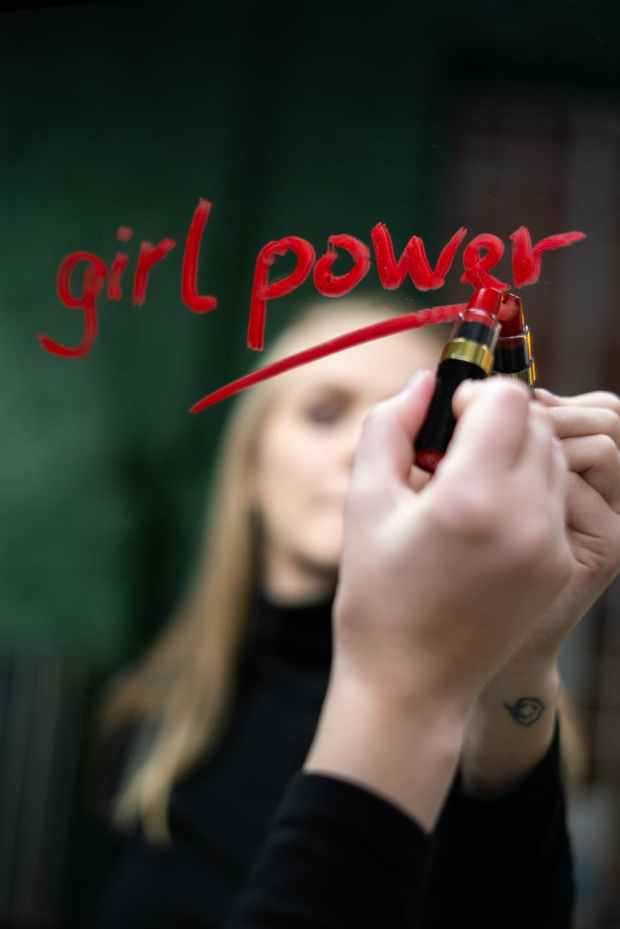
“We keep marching, our feet trampling over Principal Wilson’s threats and our teachers’ warnings. We are marching because these words deserve to be run over. Steamrolled. Flattened to dust. We are marching in our Converse and our candy-colored flip-flops and our kitten heels, too. Our legs are moving, our arms are swinging, our mouths are set in lines so straight and sharp you could cut yourself on them. Maybe we hope you do.”
Vivian Carter, Moxie, Jennifer Mathieu, p.301. *
Hello and welcome to a new blog post! I’ve had this one in the works for a while, and I’m so happy I can finally share it with you all! Just a quick little recap, my first posts for Empowered Prose and Ponders was the Evolution of the Disney Princess series and how they have changed and grown as women and people over the course of the last eighty years. I love anything, film or literature, with strong female characters at the helm, so without further ado, I am pleased to introduce you to Vivian Carter, the protagonist of Jennifer Mathieu’s Moxie.
Moxie was published in 2017, but I didn’t hear about it until I watched the film on Netflix earlier this year. After a minute or so of watching the trailer, I knew this was a story I had to see. After watching the film, I immediately ordered the book and read it in three days. The movie lit a spark in me that turned into a full-fledged fire while reading the book. Some parts had me cheering, some had me crying, and others had me feeling sick to my stomach and feeling so angry I could scream at the same time.
The story is told in a first-person point of view by Vivian, a sixteen-year-old junior who, up until now, has tried to keep her head down at her supremely sexist high school. A place where the football team rules the school with a narrow-minded and misogynistic principal backing their every move and expressing outdated and antiquated ideals on the girls. An example: the girls are subjected to dress code checks. Spaghetti strap tank tops? You’re sent to the principal’s office. Pants are too tight? You get pulled out of class. The girls are forced to wear oversize gym wear, old orange jerseys that reach past their knees. This sexist, public shaming causes Lucy Hernandez, a new student at Vivian’s school, to reference Hester Prynne, the protagonist and heroine of Nathaniel Hawthorne’s 1850 novel The Scarlet Letter.
What was, and is mind-boggling to me, is that the assistant principal accuses one of Vivian’s friends of “wearing an outfit that could distract the boys,” (p.83), but the boys never get called out of class for wearing t-shirts with messages that are disgusting and degrading to women. What are these messages? “Great Legs – When Do They Open?” is just one of them, followed by the just as sickening, if not more, t-shirt with an arrow pointing downwards and the words “Free Breathalyzer Test Blow Here.” Insert barf emoji. If the t-shirts weren’t enough, the book’s antagonist Mitchell Wilson, who is the star player on the football team and the principal’s son, and his friends enjoy saying “Make me a sandwich” to the girls, embracing and pushing the idea that girls and women belong in the kitchen.
The dress code plot device reminded me of my own high school days. Like the girls at East Rockport High, if we wore something that was considered to be a “distraction” to school, there were shirts kept in the principal’s office for girls to change into. I think if the boys were seen wearing shirts that were seen as offensive, they had to turn them inside out. I actually remember one of the hallway monitors telling me to cover up which confused me. While I was wearing a spaghetti-strap tank top, I was wearing a hoodie over it, so I didn’t think there was any problem. This person felt differently and told me my top was too low-cut and to zip my hoodie up. Years later, that still rankles because my shirt wasn’t as low-cut as she thought. I hadn’t thought about that for years, but that memory caused me to sympathize and share the anger and shame of the Moxie girls who were hauled out of class for wearing clothing that could be a “distraction.”
When Vivian tells her mother and her grandparents about this, her grandfather makes the remark “as the only person sitting here who was once a teenage boy, I can tell you, they only have one thing on their minds.” (p.105). Vivian’s mom Lisa, who was a rebellious teenager and a Riot Grrrl in the 1990s, immediately shuts the comment down by saying “It’s just contributing to the narrative that girls have to monitor their bodies and behaviors, and boys have the license and freedom to act like animals. Don’t you think that’s unfair to the girls? Don’t you think that’s shortchanging boys?” (p.105). Lisa makes a pretty good point here, the “boys will be boys” idea is unfair to not only the girls but the boys as well. It’s unfair to the girls because everyone has a right to feel safe at home, work, school, and out in public and it is unfair to the boys because “boys will be boys” enforces the toxic masculinity crap we have all grown up with. It is this conversation and her anger at the unfairness of the dress code that inspires Vivian to release the second issue of Moxie, an anonymous ‘zine she starts and circulates to her classmates.
While the first issue of Moxie is pretty tame, addressing Vivian’s irritation with the aforementioned bigoted t-shirts and “Make me a sandwich,” asking East Rockport HIgh’s female population to draw hearts and stars on their hands to help them find other girls who are just as sick of the chauvinism, the second issue takes a more immediate call to action. The second issue of Moxie gives the middle finger to the dress code checks and deliver the cold, hard truth: the dress codes have girls as their primary focus and send out the message that girls are responsible for the behavior of boys.
How do the girls fight back? In the movie, the girls protest the dress code by wearing tank tops that show their shoulders, backs and chests. In the book, the girls come to school in their bathrobes. Yes, you read that right. They get dressed for school and then wear bathrobes over top of their outfits. Moxie, aka Vivian, tells the girls that if a teacher asks what is with the bathrobes, to say that they don’t want to distract the male students. Sure enough, a teacher asks why the girls are wearing bathrobes, even going as far as to question if they didn’t get dressed that morning. One student, at the request of a female teacher to take the bathrobe off, lets her bathrobe fall to her waist, revealing a bright red bikini top. She backs up her wardrobe choice with the statement “I wasn’t sure if I was following the East Rockport dress code because it’s so weird and unclear, you know? So I decided to be safe and cover myself with this bathrobe so as not to distract any of our precious male students.” (p.128). Ouch. 30 to 40% of the female population wear bathrobes to protest the dress code, and it is this event that causes Moxie to gain more followers.
Of course, just as one fire is put out, another one begins. If we thought the sexist t-shirts and the stupid phrase “make me a sandwich,” gosh that sets my teeth on edge, were bad, the bump n’ grab takes things to a whole new level. The bump n’ grab “game” is what it sounds like: the male students bump into girls in the hallways and grab them either around the waist, pinch them on the ass and then fake apologize. Vivian is a target of this, she gets her bra strap snapped, and anyone who has had that done to them knows how much it hurts, but it’s the incident that happens to her best friend Claudia that crosses the line in a BIG way. Claudia is sexually assaulted at school in a not well-lit and empty hallway by Mitchell Wilson. I felt sick to my stomach when I read this part and as I write this blog entry, I can feel the awful metallic taste you get in your mouth when you feel nauseous.
Mitchell grabs Claudia and pins her against the wall before sliding his hand under her shirt and grabbing one of her breasts and squeezes it. As if this act isn’t horrifying enough, his response to Claudia’s pleas to stop, that he’s hurting her, he laughs at her and ignores her continuous requests for him to let go. When Claudia reports the incident to the same assistant principal who initiated the dress code checks, he tells her Mitchell was probably joking and Claudia should take the break to relax and forget about it. This makes me so angry, that this person who should be helping the students would say these things. And he makes it even worse by saying to Claudia that she should take Mitchell’s assault as a compliment.
Claudia’s sexual assault and the bump n’grab sparks the third issue of Moxie as well as the infamous “You’re an Asshole. Xoxo, Moxie” stickers. The third issue encourages girls to take these stickers and tag the property of the male students who think women’s bodies are their property. “Tag his locker, tag his car, tag his backpack.” Some girls even tag the boys themselves when they continue the bump n’grab game. The worst part for the boys? Vivian used high bond label, which makes it hard to get the stickers off. For Mitchell Wilson’s assault on Claudia, Vivian rewards his locker with ten asshole stickers.
Of course, the bolder the girls get, what with the bathrobes and the stickers, the more Principal Wilson and the administration try to silence them and mold them into “proper ladies.” Principal Wilson goes as far as to call a mandatory girls only assembly and asks Emma Johnson, the head cheerleader, to talk to the girls about “the importance of being a lady.” If he does that, then why is there no one calling a mandatory boys only assembly to talk to them about the importance of respecting women, their boundaries, and their bodies?
After the assembly, another sexist event takes place at the school, and this one is even more disgusting and depraved than the other incidents from the book that I have mentioned. This event is called March Madness, a system of brackets in which 64 junior and senior girls are selected. The brackets are created by upperclassmen boys, most namely the jocks and other popular boys at the top of the social food chain. During a two-week time period, voting and personal testimony is used to pit the girls against each other and the brackets lead to one girl in the junior or senior class. The final girl is given the title “East Rockport’s Most Fuckable.” Charming? I think not. To make matters worse, the girls are measured and compared against each other by their faces, their breast size, and what their asses look like.
The March Madness plot incident actually reminds me of the Book of Shame storyline in the first season of CW’s Riverdale. For an entire year, the jocks and popular put the girls’ names in this book as well as many points they are worth. At the end of the year, the jock who has the most points wins. Two prominent examples of women being treated as objects and not as people. The boys of East Rockport take this one step further, instead of hiding the information as the boys at Riverdale High hide their book of shame, the East Rockport boys share everything online. Every bracket update, every girl’s name is out for all the world to see, shaming and humiliating the girls. Emma Johnson wins Most Fuckable and no one is surprised that she got picked. It’s deplorable and disgusting that she has been chosen because of what her body looks like as well as the fact she is head cheerleader. The fourth issue of Moxie doesn’t have anything like the bathrobes or the asshole stickers, but sometimes a simple warning is all that’s needed. Vivian finishes the issue with the words “Remember, Moxie is always watching.”
Because Principal Wilson threatens anyone associated with the Moxie group with suspension and expulsion if they do anything on campus, the girls have to think outside the box and find another battlefield. Kiera, an old friend of Vivian’s, hosts a Moxie fundraiser at the VFW Hall off campus. She tells her grandfather, who is a Vietnam veteran, that it’s a girls’ club that talks about ways to support the football team. Sneaky, and ingenious too. Vivian is amazed at the way the girls ignore the lines of race, class, grade and popularity at the fundraiser, but I think they started to blur and fade when she started Moxie. When you’re fighting against a common enemy, the social lines that divide us disappear because we all have the same goal. In this case, to fight back against the sexism that rules our society.
The words feminism and patriarchy are mentioned a lot in this book. Two words that, when I was the same age Vivian and her friends are, weren’t even on my radar. I’d never even heard the word patriarchy and I’d only heard the word feminism once in the 2004 film Mean Girls. Feminism wasn’t a word that came up a lot in conversations when I was in high school, and when it did was usually turned into something negative. It wasn’t taboo, but it was definitely something we were not educated about. When I reached my university years, I started to hear these words more and more. In the hallways, in lectures, conversations with new friends. It was these lectures and conversations that helped me realize feminism was not what I had been told it was.
Claudia says to Vivian, “the word “feminist is a really, scary weird word to people. It makes people think you hate men.” (p.83). Feminist, feminism, two f-words that make some people react in strong ways because they fear what they don’t understand. It took me awhile and a lot of research to understand what feminist means. It means you believe in equality, and I do believe in that. Vivian sums it up perfectly when she realizes at the fundraiser, “Everyone cheers again, and soon we’re dancing, our bodies moving, one big mass of girls having fun. As I watch Lucy spin and knock her dark curls around, and as I listen to Claudia laugh and sing along (badly), it occurs to me that this is what it means to be a feminist. Not a humanist or an equalist or whatever. But a feminist. It’s not a bad word. After today it might be my favorite word. Because really all it is is girls supporting each other and wanting to be treated like human beings in a world that’s always finding ways to tell them they’re not.” (p.269).
In a bold move after the fundraiser, someone plasters an anonymous flyer calling for a Moxie walkout. These flyers are plastered all over the front doors of the school. The message reads, “MOXIE WALKOUT THIS FRIDAY AT THE ATTENDANCE BELL. I am tired of being silent. Mitchell Wilson tried to rape me at a party. I won’t be quiet anymore. Principal Wilson and the administration of ERHS REFUSED TO LISTEN TO ME. If you support this walkout: You support all girls. You support a movement THAT REFUSES TO TOLERATE VIOLENCE AGAINST GIRLS.” Another bold move, but sadly it causes a rift between Vivian and her boyfriend Seth, who is a new student at the school. When he asks her if she thinks it’s true, she’s horrified and angry and so was I. It is when we question anyone who has been assaulted, bullied or abused in any way that they are made to feel ashamed and scared into silence. Jennifer Mathieu references a really great quote by the poet Audre Lorde** in Lucy’s bedroom. “Your silence will not protect you.” Five words, loaded with meaning. I agree with Audre and I agree with Jennifer. Being silent does not protect us, what it does is make us feel like we are worth nothing, like our voices are not worthy of being heard. I was bullied for ELEVEN years; from the time I was five until I was sixteen years old. I never spoke up because I was made to feel like I was worth nothing and I have years of trauma and self-esteem issues stemming from that. Trauma and self-esteem issues that I am just starting to acknowledge and deal with after burying them for years.
Seth tells Vivian that a girl saying someone tried to rape her is a really big accusation to make against that person and that instead of letting the school handle it, this girl made a flyer and distributed it around the school. Well, Seth, when a student or an employee goes to the authority figures who are supposed to keep them safe and nothing is done, sometimes you have to take drastic action for people to hear you. Claudia is shaken because she knows that this could have been her. The flyer sets a chain of events into motion: girls are afraid but determined to walk out, Lucy gets suspended, and on the day of the walkout, Emma Johnson is the first person to move at the attendance bell. She writes Moxie down her arm and says to Mitchell, “Fuck you.” That’s all it takes for Vivian to follow her. Emma is revealed to be the one who made the flyers in retaliation to Principal Wilson dismissing her words that his precious son tried to rape her by saying that she imagined it, that it was nothing and to forget about it. More girls follow Vivian and Emma out and the climactic showdown between the administration and the girls is the moment where Vivian reveals it was her who started Moxie and made the ‘zines.
The other girls who walked out are taking pictures with their phones and join in, saying that they helped organize Moxie. Emma defiantly throws all the “importance of being a lady” bullshit out the window and tells Principal Wilson and his little moles “We won’t be quiet anymore!” (p.305). School is cancelled, and Lucy makes a blog post about the walkout and every misogynistic act that has occurred during the year at East Rockport High School before sharing it on social media and feminist blogs. The post goes viral and Vivian’s mom Lisa finds out about her being the instigator of Moxie when she sees her daughter on TV. That’s one way for the secret to come out!
In an immensely satisfying dose of karmic retribution, the school board gets involved because of the news coverage and Principal Wilson making good on his threat to expel more than half the girls in the school. After the town finds out the principal had been taking money from the funds for updated chemistry lab materials and sports equipment for girls’ teams for the football program, the Wilson family leaves town. Unfortunately, Mitchell is never investigated and charges are never pressed because he and his cowardly father leave town before he can answer for his actions. Emma tells Vivian that Principal Wilson bullied her into speaking at the girls only assembly as well as for running for vice president because he thought “having a boy as head of student council would give the council more authority overall.” (p.323). Sexist and narrow-minded much? Emma also tells Vivian that she put “You’re an Asshole, Xoxo Moxie” stickers on Principal Wilson’s truck and that he never found out she was the one who did it! Revenge and karma are dishes best served cold.
This book is one of the most empowering things I’ve read in a long time. I think I identified with the book so much because I remember what it’s like to be a teenage girl and be treated like I’m an object. There was a boy in my graduating class who sexually harassed me every chance he got, saying disgusting things like “my pants are dirty now because of her,” and I never spoke up because, like with the bullying, I thought no one would listen. After I watched and read Moxie, it lit a fire in me. I wished I’d had the guts to stand up for myself in high school and I wish I’d had the nerve to protest the way things were done there. I can’t go back and change the past, but what I can do is speak up when I see injustice and unfairness. Now and for the rest of my life. I won’t be quiet anymore. To quote the song “Speechless” from Disney’s 2019 Aladdin, “I won’t be silenced, you can’t keep me quiet, Won’t tremble when you try it, All I know is I won’t go speechless, ‘Cause I’ll breathe when they try to suffocate me, Don’t you underestimate me, ‘Cause I know that I won’t go speechless.”
If you want to know more about Moxie and check out some awesome resources about feminism, standing up and speaking out, check out the website www.moxiegirlsfightback.com. Thanks for reading. Until next time, xoxoxo
*: The quote at the beginning of this book review sums up the girls’ frustration with the administration not listening to them and taking matters into their own hands as they walk out in protest. Enough is enough.
**: Audre Lorde was born in 1934 and died in 1992. She was a Black activist, writer, and poet who used her creative gift of writing to challenge and address the injustices of racism, sexism, classism, and homophobia. If you want to know more about her, visit https://www.poetryfoundation.org/poets/audre-lorde.

