Written By: Lauren Long
Published: May 24, 2022
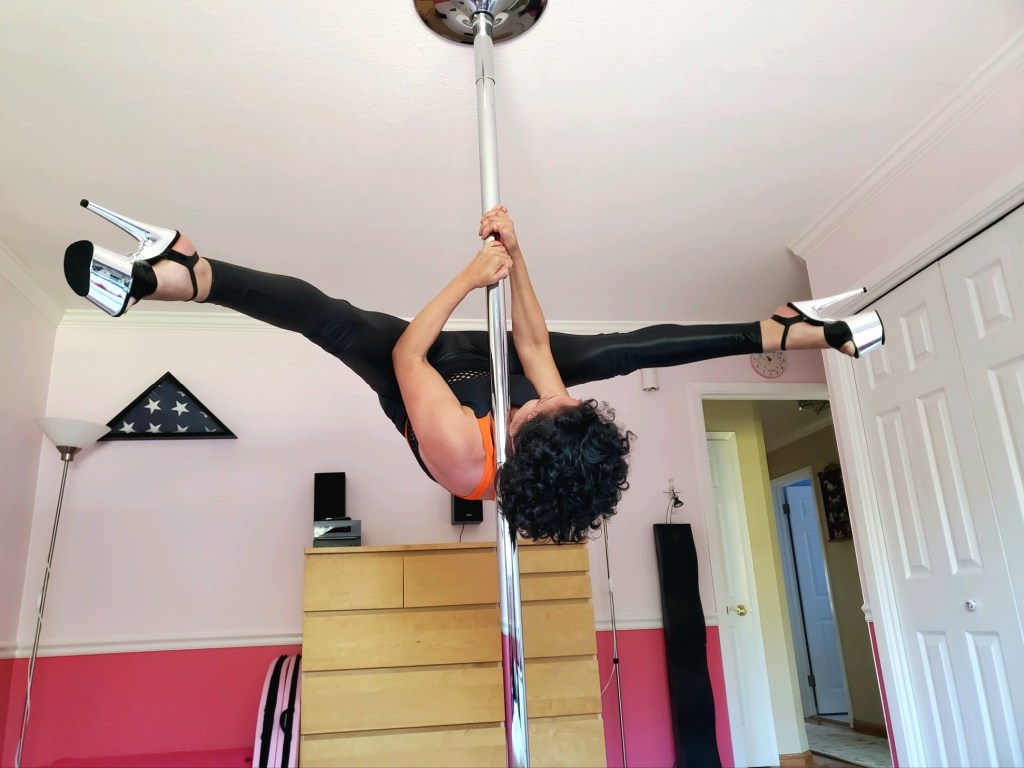
Before we dive into today’s featured story about pole dancing, let me just say how blown away I was by the attention Allison’s story received. I had no idea what to expect when I first had this idea last fall, other than the fact I knew it had the potential to go two ways. It was either not going to get attention or it was, and I’m incredibly humbled and grateful that it’s the second one. With that said, allow me to introduce Elizabeth M and her pole journey.
I met Elizabeth when she emailed me introducing herself as one of Allison’s students. Allison had approached her and another student named Rebecca to ask if they would be interested in joining this project, and once the two of them said yes, Allison passed on the questionnaire I had sent out.
How Elizabeth’s Passion for Dance Led Her to Discover the Art of Pole Dance
Elizabeth was born with a passion for dance, and it was through this passion that she introduced herself to the world of pole dance. “My mother was a big fan of Dean Martin, Sammy Davis Jr., and all those big Vegas headliners of back in the day,” she says. “I admired the glamorous long-legged showgirls and wanted to be one of them. I was aware some showgirls went topless, but I never saw that as nasty. I viewed it as an art form because they never quite took all their clothes off. Even their nipples remained covered.”
Elizabeth then goes on to add that the dancers’ creative, seductive illusion of nudity is how she fell in love with the art of the striptease and the art of burlesque. “I saw the women and all the props they used to envelop and unwrap their bodies as beautiful, but it wasn’t until my adolescence that I became aware of the use of a pole in gentlemen’s clubs. By the time I was a young adult, the Internet was in full use and it was much easier to research things. I found websites on pole dancing lessons and I was determined to try it one day,” says Elizabeth. However, it took a while for Elizabeth to make her goal of learning to pole dance a reality. Being a single mother meant money constraints, so she had to set boundaries in place for her extra-curricular activities for a long time.
Finally, 10 years ago at the age of 45, Elizabeth was finally able to take up pole dancing with the support of her husband. As she says “Better late than never!”
Physical Health and Connecting with Your Body Through Pole Dancing
Elizabeth is Latina, a native San Franciscan, and has a married 31-year-old daughter. She describes herself as a retiree and a dance enthusiast who doesn’t let her age and current health challenges stop her from pole dancing. She tells me that these are two of the biggest challenges she’s faced on her pole journey. “Despite the fact that I’ve always kept myself very active with a decent diet throughout the years, your physical health is also influenced by hormones & genetics. As I entered my menopausal years, I’ve been challenged by a few inflammatory issues that have affected my skin and joints.” Physical health, combined with hormones and genetics, can definitely have an unwelcome impact on our exercise regimens. Sometimes, depending on the day and on what our body can handle, we can do our full practice and sometimes we can do 10 to 15 minutes. And you know what? That’s okay!
One of the great things about pole dancing is that it not only increases body awareness, but it also deepens our connection with our bodies and allows us to better understand and acknowledge what our body is saying in addition to increasing our physical strength. In addition to pole dancing, Elizabeth is also into Jazzercise, Pilates and ballroom dancing, and feels as though these fitness activities have “made me powerful, as in physically stronger. I take a look at my peers, many of which are now suffering from weakening joints, poor core strength, and lack of flexibility. If I’m destined to live until my 80s, I’m determined to still have perfect splits and the ability to climb up that pole!” Elizabeth, your dedication to maintaining your physical health as well as your ability to do the splits and climb up that pole (I’m still struggling with both of these!) is inspiring!
“Pole dancing isn’t just one specific thing. It encompasses a broad spectrum of movement.”
Awareness and Educating the Public About Pole Dance
I asked Elizabeth why she thought it was important to raise awareness and educate people about the benefits of pole dancing, and her answer was “because of the health and artistic aspects of it. One has choices with the pole, amongst those are the stunts (the vertical gymnastics), sensual movement (floor work), or a combination of the two – learning to flow, gracefully, from the pole to the floor and back. Either way, it is quite the workout, physically and mentally. It involves cardio, flexibility, core work, weight lifting (one’s own weight), and creativity. Does it have to involve stripping off layers of clothing? No, it doesn’t, unless you want to incorporate that as part of your movement and your dance. Does it have to involve the use of platform heels, aka stripper heels (a term I don’t like to use, once again due to the backwards stereotype attached to it)? No, it doesn’t, but using platforms gives you the extra challenge of added weight, at least three pounds more.” I’ve used the platform heels Elizabeth mentioned, with little success, so let me take a moment to give a shoutout to her and anyone else who can wear those shoes with confidence!
In addition to answering my question about educating the public further about the benefits of pole dance and her thoughts about sensuality in pole dance, she added to that thought with two questions of her own, therefore deepening the thought of what sensuality is and what it means. “What is sensual movement? Sensual dance?” she asks. “Sensual means physically pleasing. It has to do with our five senses,” she says before continuing, “It is often used in a sexual context, but is not exclusively sexual in meaning. Any movement can be considered a dance move. Dance involves the awareness & expression of self. So much so that it’s been used therapeutically, and I’m not only talking about physical rehabilitation. I’m referring to working with individuals living with dementia, those who are struggling with overcoming trauma, and other mental health issues.”
As someone who has mental health issues and is working through a very complicated web of trauma that has built up over the years, I fully agree with and can personally attest to pole dancing being therapeutic.
I’m going to conclude this section with Elizabeth’s hope for the outcome of this project. “I hope to see in my lifetime, the respect and admiration that pole dancing deserves. For many years, I’ve been hoping to see it recognized as a sport in the Olympics,” she says before adding, “The stunts I now see performed by younger generations are beyond amazing!!! Furthermore, amongst pole dancers themselves, I hope to see the mutual respect between those who practice tricks and those who focus on floor movements around the pole. Sadly, I’ve heard negative comments from some in the pole world, claiming that sensual movement isn’t really pole dancing. Such remarks undermine the art form. Pole dancing isn’t just one specific thing. It encompasses a broad spectrum of movement.”
Blood, Sweat and Tears as Mental and Physical Challenges
Once you’re in the pole world, it’s an exhilarating feeling. Not only have you found something that makes you feel like you’ve woken from a very long sleep, but you also discover things that you didn’t know your body was capable of doing. I heard someone say once “Your body will only go where your mind will let it,” and that’s stuck with me ever since. I never would have dreamed that my body was capable of doing half the stuff I do on the pole.
Of course, with hard work comes blood, sweat, and tears, and I mean that in the most literal sense. On the physical side, in addition to bruises, there’s the aforementioned sweat. Elizabeth told me that sweat was one of the things that she struggled with the most when she first started, and she continues to work with it to this day. “I’ve always sweated a lot and sweat is definitely not your friend when you’re on the pole! I have yet to find the right kind of grip that dries my hands, but not too much, I’d like a little bit of give so that I can still freely spin without getting stuck!” I have the same problem. There are grips in liquid form that pole dancers use, I have one myself that comes in handy when I’m climbing or doing aerial squats, but the second I try to do a spin I get stuck and I can’t move my hands.
On the mental end, it can be really hard to shut down the negative voice, or voices, in your mind. For every trick or spin that you master, there are always movements that you struggle with. When you add in those negative voices and get lost in your own head, you’re bound to leave your pole disheartened, discouraged, and just plain annoyed with yourself.
Remember that sensual movement I talked about earlier? Elizabeth told me that this was the second thing she struggled with. When it comes to sensual movement and dancing spontaneously from her heart and soul, with no choreography or anticipating movements, and getting out of her head, Elizabeth found her greatest challenge. “Before coming to pole, I had always danced to my own or someone else’s choreography in my dance classes. I’m a planner, so it was a challenge for me to simply let go and let the music envelop my senses and carry me. It took me at least three years to learn how to slow down with my breath and my dance, and allow my movements to come forth organically.”
The Perception of Pole Dance and Other Obstacles
When I sent out the questionnaire to Allison, Elizabeth, and the other pole dancers who joined me on this project, I asked their opinions on if/how the perception of pole dance has changed and what the biggest obstacles are that we face in addition to our personal and physical hurdles. The answers varied, but Elizabeth’s answer was that aside from injury, the backward stereotypes that still exist about pole dancing. She feels as though “further attention to the sport is needed in order to successfully educate the public.”
I agree with this statement, further education is needed and it is my hope through this project that we will continue to build up awareness. When asked if she feels as though the perception of pole dance has changed for better or worse, Elizabeth replies, “I pursued pole dance for myself and I really didn’t care what the perception was, so this question had never crossed my mind until I started taking pole classes. A couple of weeks ago, I heard from a fellow classmate that she recently wore a hoodie with the words “I love pole dancing” or some such statement to her gym, and she said someone made an insinuating remark. I guess that tells me that an ignorant perception remains and I don’t know if it’s held by the majority of the public, both men and women, or one or the other, but I do think it might be due to 1) Pole is not yet recognized as an artistic sport, and 2) Confusing sensual movement with sexual.”
Isn’t it strange that when we start doing something, like pole dancing, is the moment that the question of others’ perception of it makes itself known to us? We hear constantly if we really love something to not care about what other people think of it, but it’s hard when you’re getting mixed reactions. I’ve found that when someone hears that I pole dance and they have a negative reaction, I immediately go on the defensive. I have a hoodie with pole dancers all over it that I absolutely love, and I haven’t worn it out in public at this point. Still, I have a feeling that if/when I do, I can probably expect a reaction similar to the one Elizabeth’s classmate encountered. But then again, I might get a positive reaction, so it could go either way really.
For anyone who is interested in pole but is hesitant to try it because of the stigma around it and the potential negative reactions of family and friends, Elizabeth has some advice for you: “If you’re a single adult, you don’t owe an explanation to anybody. You pursue an activity for yourself. If you’re curious about the pole, try it out! There’s nothing to lose! If you don’t like it, then you stop! If you’re married, and you’re concerned about what your spouse will think, educate them about the sport. If you’re unable to have open communication with your spouse, the pole is the least of your problems.”
“The biggest benefit of pole dancing is related to your psychological and emotional health. When you’re stressed, adrenaline begins to build in your body and you become anxious, easily annoyed, and depressed. An intense pole dancing session gets rid of all that adrenaline and replaces it with endorphins.”
Background in Dance
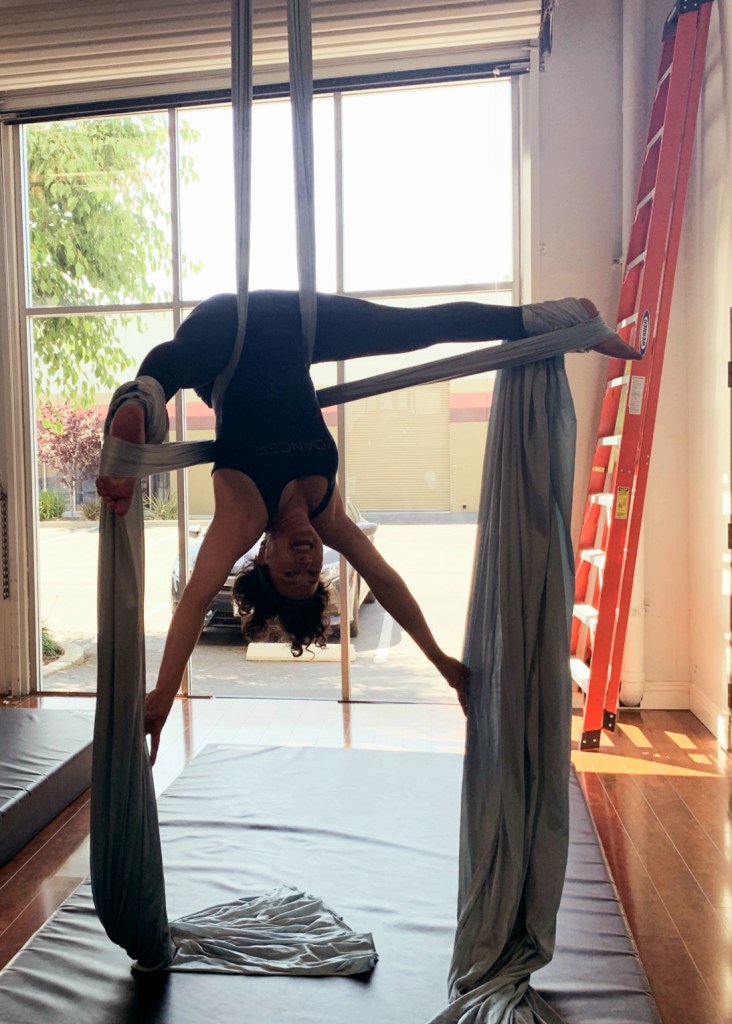
No matter what type of dance it is, Elizabeth is always game to try something new. “Dance has always been a part of my life since the age of 4,” she says. “My mother spent a fortune on my classes as I was growing up. My foundation is ballet and acrobatics, but from there I branched out to jazz and tap (my favourite genres of dance). I dipped my toes into gymnastics, ice skating, and folkloric dance such as Greek dancing, belly dancing & flamenco. In my adulthood, I ventured into ballroom dance (waltz, rumba, salsa & Argentine tango), which continue to form part of my weekly fitness regiment along with pole dancing.” That is quite the dance resume! I watched Dancing with the Stars religiously in high school, and I became enamoured with the types of ballroom dancing that Elizabeth just listed. I’ve always wanted to try them but haven’t had the chance. Maybe one day!
Because of her lifelong love affair with dance, Elizabeth has very strong beliefs about how healing and emotionally freeing dance can be. “I can’t say that pole has changed me,” she says before adding “I can say that it has maintained my physical and mental well-being like all my dance activities have throughout my life. I’m now retired, but previously held a high-stress job and dance has always been my therapeutic escape.” I think no matter what work environment we’re in, it’s so important to have a creative outlet and a form of physical fitness that allows us to move through our emotions and escape from the stressors of our everyday life. We’ve got to keep those cortisol levels low!
When asked about pole dance being a healing source for trauma, Elizabeth responded that “Dance itself, whether it be pole or some other movement, is a powerful tool. It involves such depth of passion, that it has helped me vent and purge myself of a few powerful emotions, such as grief and anger.” I’ve definitely found that after a pole training session I feel calmer and happier. I’ve danced my way through whatever emotions I’m feeling, whether those emotions are anger, sadness, fear, guilt/shame, and so on. The benefits of pole found on tantrafitness.com states that the “biggest benefit of pole dancing is related to your psychological and emotional health. When you’re stressed, adrenaline begins to build in your body and you become anxious, easily annoyed, and depressed. An intense pole dancing session gets rid of all that adrenaline and replaces it with endorphins.”
Family, Friends, Strangers and the Pole
You may remember from Allison’s story that initially; her family was not supportive of her pole dancing and she had to keep it a secret at first. Elizabeth’s story is quite different. “My family and friends have always known me to be a fan of dance. It’s my passion,” she says. “I can be in a dance studio every day of the week no problem. So, I’ve never experienced a negative reaction from them. My husband has been my strongest supporter and is very proud of my accomplishments on the pole.” It makes me so happy to hear that, Elizabeth, you have no idea! It is a dream or more of a hope, that I will find someone who not only accepts that pole dancing is a big part of who I am, and also that they are supportive.
Elizabeth says that she has not encouraged her family and friends to come and try out the pole because they “have clearly defined passions and hobbies of their own, none of which is dance.” She then goes on to add that she doesn’t post videos or pictures of herself pole dancing because she’s not into social media, which in this day and age is totally understandable due to how much negative content that makes its presence known. ‘However, I do recall a couple of times where my pole activities have come up in conversations and these women expressed curiosity about pole fitness. I remember I provided them with the websites of the pole studios where I had taken classes, but I don’t know if they followed up.”
How Pole Influences Body Confidence in the Face of Societal Expectations
For years, societal expectations of what a woman’s body should look like have invaded our minds and altered how we see ourselves, sometimes to a dangerous extent. When we hear the negative opinions of others, whether it’s strangers on the street or on social media, or even from people we know, we start to take that inside, thus damaging our sense of self-worth and having an unhealthy body image. Elizabeth feels that pole has maybe not helped her reclaim parts of herself that she lost, but rather “helped me to accept and appreciate the uniqueness of all my body parts and how they come together when I dance. I’m my greatest critic. I used to frequently be telling myself that such a move would look better if I was thinner or if I was taller, etc. I would be comparing my middle-aged self to the 20-year-old me. Fortunately, throughout these 10 years, I’ve been exposed to some wonderful instructors and supportive classmates that have helped me to find the beauty in my body.”
When you have people to help you replace the negative perception of your body with a positive one, it not only changes your mindset towards yourself but also in other areas of your life. Elizabeth tells me that just like her other dance activities, pole dance has “kept me mentally and physically fit. Moreover, it has introduced me to many like-minded and mutually supportive women. A few of which I’ve come to consider friends.” It’s a wonderful feeling to find people who are encouraging and who share the same interests as you do. When you surround yourself with people who build you up and cheer you on, your self-esteem and self-image grow in a positive way. “Pole has increased my self-esteem because this journey has given me a greater appreciation of my body and that, in turn, positively affects your self-esteem,” Elizabeth says.
Body confidence and sensuality are what Elizabeth has gained, and continues to gain, from her pole journey. “The sensual aspect of pole definitely unlocked the feeling of greater comfort & appreciation of my body,” she says. “Throughout our lives, women, primarily, are bombarded by the social media with the message that we are deficient. From makeup to clothes, etc. “Wear this to look slimmer,” “Use that for younger skin,” and the older you get, it gets worse. We’re definitely still living in a society that does not appreciate the beauty of an older woman. Men, however, have it made. “Men age like fine wine.” I’ve never heard a saying like that applied to women.” Now that I think about it, I haven’t either.
Community, Kinship and Connection in Pole Dance
In a world where there is so much judgment, negativity, and criticism of ourselves and others, the pole studio can be a safe haven, an escape from the world outside. “What I enjoy most about my pole community & others that I’ve heard about, is that everyone is non-judgmental, mutually supportive and very enthusiastic about the sport. We cheer each other on!” says Elizabeth.
She then adds her thoughts about what pole can bring to peoples’ lives: “As with any sport, physical and mental health plus a sense of community. Human nature is largely gregarious. We like to belong. We enjoy coming together with like-minded individuals to have fun. And just like with any sport, pole also has its unique characteristics, one of them being sensual movement, which brings greater attention to, comfort with and acceptance and appreciation of one’s entire body without judgment.”
When I read Elizabeth’s response to this question, I felt an instant connection to her words and to her. We do like to belong and we do like connecting with people who are like us, and that’s something I’ve searched for my entire life, and I’ve finally found it with the pole community. Destynnie Hall backs up Elizabeth’s belief and my feelings in her article “The Benefits of Pole Dancing,” when she says that “pole dancing revolves around sports, self-confidence, expression, and sexual empowerment, almost everybody within the community feels the social stigma to some degree. That’s part of what makes the pole dance community one of the most inclusive, supportive communities to be a part of.”
Accomplishment and Emotions
Elizabeth said that the word she would use to describe pole dancing is thrilling before going on to explain why. For her, this means “a combo of fun, exciting, scary, along with a strong feeling of accomplishment. I remember the first time I was able to let go and do a lay-back from high up on the pole—terrifying!! However, it made me feel strong, like Super Woman!!” I haven’t attempted a lay-back yet, in any way, shape or form, but I do understand what Elizabeth is talking about when she feels the emotions of excitement and accomplishment. I don’t think there are words to describe the way you feel when you finally achieve the trick or spin that you’ve been working on for ages.
Inspiration On and Off the Pole and How it Became a Main Part of My Life
When it comes to inspiration, Elizabeth says “I’ve been so fortunate to have been exposed to a few gifted instructors, such as Allison H, but I must attribute my inspiration to my first instructor, who continues to be my personal fitness guru, and someone I can honestly call my friend. When I grow up, I’d like to be Deb Arana! Now in her early 60s, she’s done it all. The woman is so accomplished – a black belt in Jiu-Jitsu, runs a Pilates business, co-founder of The Alt Feminine (thealtfeminine.com), bow hunter (a true Katniss Everdeen!!), and pillow fighting champion! I can go on and on, but to answer the question, the first time I saw her slinky sensual movement, involving a slow strip, gracefully flowing from pole to floor and back, I’d never seen anything so captivating up close. I’ve observed a lot of fast hard pole moves, which is pretty cool, but I’ve actually seen pole dancers who can slow down to that point of being breathless and breathtaking.”
Wow! Did anyone else feel awed and inspired by hearing Elizabeth’s praise of Deb? I know I did. After meeting Deb, Elizabeth knew for certain that pole dancing was going to be part of her ongoing fitness regimen. “I was in awe,” she says. “I so wanted to learn how to do that. It’s been 10 years and I continue learning, slowly but surely, and I hope to never stop. It fulfills me, despite the difficulty, and it provides me with such a feeling of accomplishment and satisfaction.”
So ends the second story of the Empowered Pole Project, a mission dedicated to raising awareness about the art of pole dancing and educating the public further about this thrilling, amazing sport and community that we are proud to be part of.
Thank you, Elizabeth, for allowing me to share your story and for being a part of this movement.
To my readers, as always, thank you for reading, and I’ll see you next time. Until then, xoxoxo
If you’re a pole dancer and you’d like to share your pole journey, I’d love to hear from you!
To get in touch:
Instagram: @laurla731
Email: lalong731@gmail.com
The photos and written content in this article were used with consent.
Sources:
The Benefits of Pole Dancing, Destynnie Hall – https://polepedia.com/the-benefits-of-pole-dancing/ – Published August 31, 2019
The Benefits of Pole – https://tantrafitness.com/tantrafitness/benefitsofpole/

