Written By: Lauren Long
Date Published: September 4, 2026
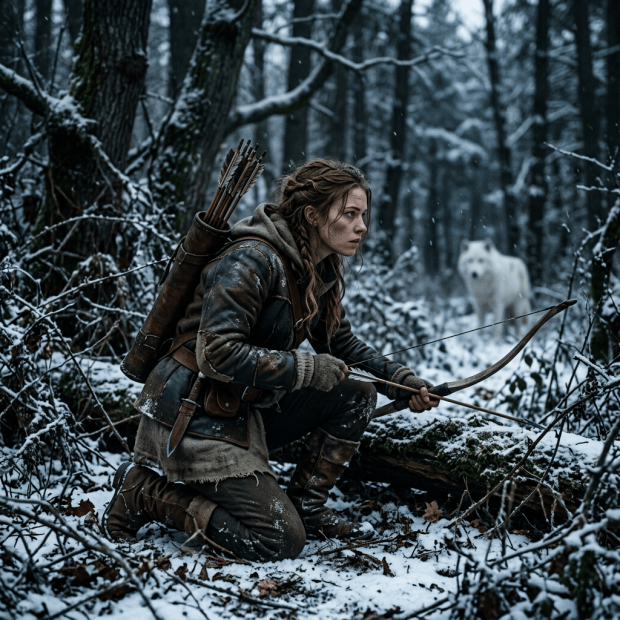
Before she was High Lady of the Night Court, a wife, and a mother, she was a huntress and breadwinner for her family. A survivor, protector, and reluctant killer.
Feyre Archeron, the youngest daughter of a once-wealthy, successful merchant, is the third-born Archeron sister. From the time she is 14 years old, her only goal is to survive. When we meet Feyre in the titular novel of Sarah J. Maas’s A Court of Thorns and Roses series, she’s a 19-year-old who has spent the past five years as the sole provider for her family, carrying burdens no teenager should have to.
Her identity as a huntress in A Court of Thorns and Roses is the foundation for the woman she becomes. Poverty forces her into a role that is defined by survival, sacrifice, and violence, but the skills she develops as a provider ultimately become the same qualities that allow her to survive Prythian and Under the Mountain and eventually become a powerful leader.
Feyre’s hunting began when she killed a young rabbit out of desperation and hunger, though this came at great personal cost. She remembers that after her family ate it, she went back to the woods and cried for hours because she felt like she had crossed a moral line. She didn’t begin her role as a provider comfortable with killing, nor is she naturally bloodthirsty. Necessity is what teaches her to kill.
The first kill that we physically see is Feyre killing the doe, and this is an important moment because it tells us that her hunting isn’t just a skill; it is what has been ensuring her family’s survival. Her decision to go after the wolf is even more revealing. She knows the danger of killing it, but the possibility of obtaining its pelt is worth the risk because her family’s survival depends on what she can bring home.
Later on, Feyre becomes capable of violence, but her earliest experience with killing is connected to grief and guilt, and her relationship with killing changes because her circumstances force her to repeatedly cross boundaries she initially believed she couldn’t cross.
In many ways, Feyre is similar to Katniss Everdeen, the heroine of Suzanne Collins’s Hunger Games series. They both became teenage providers after the collapse of their families, but their relationships with hunting begin very differently. Katniss inherits her hunting skills from her father, while Feyre develops hunting out of necessity.
Living in devastating poverty, Feyre ensures her family’s survival as she hunts in the forest near their home. If there is an underappreciated family member in the Archeron clan, it’s Feyre. Despite being indispensable, her family doesn’t appreciate her single-handedly keeping them alive. Her father and two older sisters make no effort to contribute to the household, and Nesta and Elain often spend the money Feyre earns to buy things for themselves instead of finding their own employment. Feyre isn’t simply poor; she has been made responsible for solving the consequences of everyone else’s failure.
Feyre’s relationship with her father holds a great deal of resentment, and a large part of it is because Feyre is doing what he no longer can, or won’t, do. When he was a successful merchant, Feyre remembers going to his office with him and learning about the different places in the world and about the wares that came from them. That man faded away when he lost the family fortune and debt collectors broke his legs, leaving him unable to walk and traumatizing his three young daughters. The father she remembers and the father she has is what makes her resentment toward him so complicated. Feyre is someone who was once protected and given glimpses of a larger world. After her father’s downfall, she becomes the person who must protect him.
Nesta and Elain’s dependence affects Feyre emotionally because the roles have been reversed. As her older sisters, they should have been the ones protecting Feyre and working to support the family. Instead, the youngest is providing the family with money, food, and clothing, leading to years of her feeling largely unseen and unappreciated by the people she’s keeping alive. Feyre has become the protector of everyone who should have protected her. And yet, she does it because of a single request from her mother.
We never meet Feyre’s mother on-page, but as Feyre’s story unfolds throughout the series, we get a pretty clear picture of the kind of mother Feyre had. On her deathbed, Feyre’s mother asks her youngest daughter to protect the family. That request places a heavy burden on Feyre’s shoulders that she continues to carry despite her resentment towards her living family members. It’s never explicitly stated that Feyre bears a grudge against her mother for asking that of her, but she carries her mother’s dying wish for a long time, living as though that promise is binding.
These unequal family relationships are what make Feyre’s eventual longing for a different life so poignant. She has learned that her worth to her family is connected to what she can provide.
In the first book, Feyre cannot read or write, which makes her daily life harder because she has to rely on her bartering skills to bring in income. However, Feyre’s hunting skills are not the only ones she possesses: she also has a raw talent for painting, and she says that her dream is to make enough money and provide her family with enough food so that one day she can spend her days painting.
Before Prythian, she has very little opportunity and resources to develop that part of her identity because survival takes precedence. The huntress is the identity and role that poverty forces her into, while the artist is the self she might have pursued had she been given the choice.
Feyre has two identities that exist side by side: the huntress and the artist. The huntress embodies survival, responsibility, hunger, violence, sacrifice, and practicality, while the artist epitomizes imagination, beauty, freedom, self-expression, and desire. The true tragedy is that Feyre doesn’t have the luxury of choosing the artist; she has to become the huntress first.
When she decides to hunt and kill the wolf, it demonstrates Feyre’s willingness to prioritize her family’s survival over her own safety. When she leaves the human world, Feyre doesn’t leave the huntress behind. The resourcefulness, vigilance, independence, willingness to act, courage, protectiveness, and an ability to make hard choices that hunting forced her to develop become crucial to her survival in Prythian and Under the Mountain.
One choice, one fateful trip into the forest, changes everything about Feyre’s life, setting her on a path she never could have imagined.
This is only the beginning of her story. The High Lady of the Night Court doesn’t emerge out of nowhere. Before she had a crown, a court, or a family of her own, she was a starving girl who learned how to survive with a bow in her hands. She became a huntress because she had no other choice, but beneath her survival instincts, there was always an artist who wanted the freedom to become something else.

